GigantiCo Art Director Chris Grayson Art Director, New York City
Chris Grayson Art Director - LinkedIn Art Director Chris Grayson - Facebook Art Director Chris Grayson - Delicious Art Director Chris Grayson - Twitter Art Director Chris Grayson - Library Thing Art Director Chris Grayson - Last.fm Art Director Chris Grayson - Second Life Art Director Chris Grayson - Art Directors Club Art Director Chris Grayson - Krop Art Director Chris Grayson - Behance Art Director Chris Grayson - Coroflot Art Director Chris Grayson - Shownd Art Director Chris Grayson - Creative Hotlist Art Director Chris Grayson - Carbonmade


SEARCH THIS SITE:
powered by FreeFind


SITES OF INTEREST:

Augmented Reality
ARmeetup.org | Video Hub
Twitter AR Peeps
Games Alfresco
Curious Raven
UgoTrade
The Connected World
AR Times
Augmented
Augmentation
Augmented Planet
Augmented Environments
Organized Chaos
The Future Digital Life
Augmentality
Augmented Reality 3.0
AR Newsroom
AugmentPro
The Augmented Blog
AR at ReadWriteWeb
Augmented Reality Network


Virtual Reality / Metaverse
3pointD
eightbar
Ian Hughes’ ePredator
Gwyneth Llewelyn
distilling the metaverse
Reubens Thoughts
Daneel Ariantho’s Lab
Tao Takashi’s life in SL
Metaversed
Second Life
Second Life Topsites


New Media, Marketing
& Trend Spotting

Seth Godin
Jaffe Juice
Greg Verdino
Meme Huffer
Mashable
Presentation Zen
Darren Herman
Idea City
Guy Kawasaki
Sramana Mitra on Strategy
Techno//Marketer
Ad Holes
Web Strategy by Jeremiah
Third Way Blog
AdverBlog
Ad Freak
Every Dot Connects
ExperienceCurve
Global Neighbourhoods
MicroPersuasion
AdFreak
TrendHunter
Steven Berlin Johnson
Malcolm Gladwell
Rand in Repose
The Long Tail
Kevin Kelly
Bob Parsons
Ted Blog
Marian Salzman
GrowBrand
Interactive Mrkt Trends
AdLiterate
Advergamez
Common Craft
CK Blog
BrandNoise
Deep Jive Interests
Digital Biographer
Roo Reynolds - What’s Next
Conversation Agent
The Client Side
SaaStream: CRM Strategy


Culture
Burn Lab
Dark Roasted Blend
Architectradure
Brass Goggles
Juxtapoz
Positive Ape Index
Supertouch Blog


The Counter Media
BoingBoing
Laughing Squid


Design/Lifestyle Portals
Notcot
Moco Loco
Curbed
reBang
Core77
Design Addict
Apartment Therapy
Uncrate
design:related
Cool Hunting
Contagious Directory
Swiss Miss
Uppercase
electro^plankton


Architecture Zines
[pushpullbar]2
Archidose
ARCspace
Bldg Blog
Arkhitekton
ArchiNow
Archinect
Great Buildings
Emporis Database
Five Foot Way
uno punto seiscientos dieciocho
eye candy
materialicio
WorkSpace
The Architects Paper


Information Graphics
Visual Complexity
Infosthetics
Information Architects
XPLANE
Nicholas Felton Blog
FlowingData
Aaron Koblin
Nixon Now
Think Map
Many Eyes
Edward Tufte
Topicscape Mindmaps
Periodic Table of Viz.
Prefuse Toolkit
TouchGraph


Website Design lists
The F.W.A.
Cool Home Pages
The Best Designs
Adobe Showcase
Ultrashock


Graphic Design
A List Apart
ping mag
Bartelme Design
Be a Design Group
Before & After
BittBox
Brand New
David Airey
Designer Daily
Design Inspiration
Designologue
Designers’ Toolbox
Designers Who Blog
Etcetering
LogoPond
Under Consideration
Zeldman


Color Tools
Adobe Kuler
Colour Lovers
Stripe Generator
Palette from Image 1
Palette from Image 2
NASA Color Tool
Shade Generator
Color Jack
Color Blender
Color Mixers
VisiBone Color Tools
Easy RGB
Color Conversion


Stock Asset Sites

Stock Images:
   Getty Images
   Corbis
   Veer
   iStockphoto
   Shutterstock
   British Library
   Acclaim Images
   StockXpert
   PhotoShelter
   Jupiter Images
   World of Stock
   FotoSearch
   Photos.com
   Rubberball
   FotoLia
   Snap Village
   Crestock
   123RF
   StockPhoto
   Blend Images
   PhotoLibrary
   ShutterPoint
   Photographic Libraries

Free Stock Images:
   Free Range Stock
   Yoto Photo
   EveryStockphoto
   FreeFoto
   Free Digital Photos
   Free Photos Bank
   Open Stock Photography
   Stock.XCHNG
   The Stock Vault
   The Morgue File
   American Memory
   NASA Research Aircraft

Stock Vector Art:
   Go-Media Arsenal
   iStockphoto Illustrations
   Shutterstock Vector
   FlavaFX
   Art Bitz
   VectorStock
   The Vector Lab
   StockVectors
   Clipart-Design
   Vector Cafe
   Clipart Lab
   Digital Auto Library
   Presentation Maps
   Digital Vector Maps
   Map Resources
   Illuminated Manuscripts
   Coat of Arms

Free Stock Vector Art:
   All Free Logo
   Brands of the World
   SeekLogo
   Share a Logo
   Deviant Vector Art
   Free Vecotrs
   Vecteezy
   Snap 2 Objects
   Open Clipart
   Webchantier

Sound FX:
   Minimal FX
   Sound Snap
   Sound Rangers
   Sound Dogs
   Sonomic
   Flash Den Audio

Stock Music:
   AudioSparx
   Partners in Rhyme
   Abstract Beats

Free Audio:
   Sound Snap
   Free Sound
   Free Sound Effects
   Free Loops
   Flash Kit Sound FX
   A1 Free Sound Effects

Audio Web Search:
   Find Sounds

Stock 3D Models:
   3d02
   DAZ 3D Models
   3D Science
   TurboSquid 3D
   The 3D Studio
   Poitra
   3A Games
   3D Export
   The 123d, 3D Models
   3D Model Works
   Objects Library
   Alfaville Automotive
   3drt Game Models
   Precise 3D
   Amazing 3D
   Altair Models
   Arch Objects
   AXYZ Design

Icons:
   Icon Factory
   Fast Icon
   iconaholic
   DeGraeve Favicon Maker

Stock Flash Components:
   Flash Den
   Swish Zone
   Screen Time
   MultidMedia.com

Stock Video:
   Pond5
   RevoStock
   Getty Footage
   Corbis Motion
   iStockvideo
   Photo Library Footage
   Thought Equity
   Advance Flash
   Footage Firm
   Shutterstock Footage
   Royalty Free HD
   Footage House
   Footage House HD
   Video Tape Library
   Always HD
   avc HD clips
   DV Cuts
   Feedback Video
   Livid Instruments
   Motion Loops
   World Clips
   Wrightwood
   Ocean Footage
   Global Cuts
   Nature Footage
   Wilderness Video
   Timelapse
   Extreme Storms
   Storm Stock
   Mt. Hurricane
   Teton Gravity Research
   e-Aerials
   America by Air
   Tony Monk Films
   Pro Aerial Video
   Aeronautic Pictures
   

Fonts

Font Houses:
   Adobe
   LinoType
   Hoefler & Frere-Jones
   Blambot
   House Industries
   T.26 Fonts
   Device Type
   Emigre Fonts
   Fountain
   P22 Online
   Comic Book Fonts
   Jukebox Fonts
   Self Built Fonts
   TypeCo
   Intl. Typeface Corp. (ITC)
   Alias
   Garage Fonts
   Elsner + Flake
   Shinn Type Foundery
   Font Menu
   Letterhead Fonts
   Letterhead Logos Type
   Classic Font Company

Pixel Fonts:
   Fonts For Flash
   Flash Den
   MiniFont
   04 Bitmap (free)
   Pixilate
   Alpha Omega
   Kottke Silkscreen (free)
   Atomic Media
   BitmapMania (free)
   Fonts by Cal Henderson
   OrgDot (free)

Handwriting Fonts:
   Dephitro (free)
   Pixilate (handwriting)
   vLetter Ready-Made
   Teacher’s Fonts (free)
   Educational Fontware
   Fontifier

Font Stores:
   Veer
   Font Haus
   Fonts.Com
   MyFonts
   Font Shop
   HighFonts
   House of Type
   The Font Pool

Free Fonts:
   Simply the Best Fonts
   daFont
   1001 Free Fonts
   Dieter Steffmann’s Fonts
   House of Lime Fonts
   SpoonLoads
   HighFonts Free
   04 Bitmap
   BitmapMania
   Wanted Fonts
   Kottke Silkscreen
   DincType
   Get Free Fonts
   Download Free Fonts
   OrgDot
   Dephitro (handwriting)
   Font Shop Free
   Flood Fonts Free
   Better Fonts
   Search Free Fonts
   Urban Fonts

Font Identifiers:
   by partial name
   by appearance
   from a reference image

Typography Websites:
   Typophile
   TypeNeu
   Type Directors Club
   I Love Typography
   Design & Typo le Site
   Car Type
   McGill U., Typography
   

Gadgets
Gizmodo
Think Geek
engadget
Oh Gizmo!
WIRED Gadgets
Gadget Review
Coolest Gadgets


The Future
Ray Kurzweil
Foresight Institute
Institute for the Future


Robots

Robot Clubs:
   Survival Research Labs
   Carnegie Mellon Robotics
   List of International Clubs

Robot Blogs/Zines:
   Robotics at NASA
   Robot Dreams
   Robot Advice
   BotMag
   Go Robotics
   Inst. for Robots in Edu.
   Walking Robots

Household Robots:
   Probotics
   UBOT
   iRobot - Home
   Karcher

Mobile Robots:
   Inuktun
   Autonomous Solutions
   iRobot Industrial
   American Standard
   RoboProbe
   Roper Resources

Walking Robots:
   Honda ASIMO
   PLEN
   Austrobots
   Lucy
   Kawada HRP-2 “Promet”

Flying Robots:
   Rotomotion
   General Atomics
   ACR Tucson
   DIY - UAV
   DIY Drones

Factory Robots:
   RobotWorx
   Robot Co.
   Used Robots
   Industrial Control Repair
   Epson Robots
   ABB Robotics
   Antenen Research
   Fanuc, FA & Robot

Robots Kits:
   Arrick Robotics
   LynxMotion
   Science Kits, Robots
   Robots Direct
   Hobbytron Robots
   

N.Y.C. Art Museums
MoMA
The Guggenheim
The Metropolitan
The Whitney
New Museum of Con. Art
EyeBeam
National Design Museum
Chelsea Art Museum
The Brooklyn Museum
The Queens Museum
The Bronx Museum
Int. Center of Photography
Neue Galerie (German/Austrian)
Austrian Cultural Forum
The Asia Society Museum
The Jewish Museum
The Skyscraper Museum
Museum of Art & Design
American Folk Art Museum
Museum for African Art
ArtSlant - New York


Buy Affordable Art
Etsy Art
Raandesk Gallery
Artocracy
GigPosters Classifieds
Expresso Beans Store
U Gallery
Poster Bomb
Art Prostitute
Illustration Mundo
HANG art
imagekind
Tiny Showcase
deviantART
Fine Art @ Shana Logic
PhilaArts
ebay Art


Friends
Ric Agudelo
Brad Ascalon
Dan Breton
Mike Brown
Shawn Cripps
Billy D’Ambrosio
Bob Epstein
Mark Feigenson
Ryan Hwang
Sven Johnson
Vinton Lennon
Al Risi
Mark Scott
Michael Lyons Wier
Will Znidaric


GigantiCo is the blog of,
CHRIS GRAYSON
Art Director, Design Director
New York City


The Cluetrain Manifesto:
The End of Business as Usual

by Christopher Locke,
Rick Levine, Doc Searls,
& David Weinberger

The Long Tail:
Why the Future of Business Is Selling
Less of More

by Chris Anderson


Wikinomics:
How Mass Collaboration Changes Everything

by Don Tapscott,
& Anthony D. Williams


Mondo 2000:
A User’s Guide to the New Edge : Cyberpunk, Virtual Reality, Artificial Life and More.

by Rudy Rucker,
R. U. Sirius
(aka, Ken Goffman)
& Queen Mu
(aka, Alison Kennedy)


The Singularity Is Near:
When Humans Transcend Biology

by Ray Kurzweil


Future Shock
by Alvin Toffler


Global Brain:
The Evolution of Mass Mind from the Big Bang to the 21st Century

by Howard Bloom


Out of Control:
The New Biology of Machines, Social Systems and the Economic World

by Kevin Kelly


Great Mambo Chicken and the Transhuman Condition: Science Slightly Over the Edge
by Ed Regis


Turing’s Man:
Western Culture in the Computer Age

by J. David Bolter


On Intelligence
by Jeff Hawkins


Everything Bad
is Good for You

by Steven Berlin Johnson


Form follows Finance:
Skyscrapers and Skylines in New York and Chicago

by Carol Willis


Delirious New York:
A Retroactive Manifesto for Manhattan

by Rem Koolhaas


The Devil in the White City:
Murder, Magic, and Madness at the Fair that Changed America

by Erik Larson


The Machine Plays Chess
by A. G. Bell


Prisoner’s Dilemma
by William Poundstone


Blog Flux Local - New York

Art Blogs - BlogCatalog Blog Directory

THE BOBs


Clicky Web Analytics


« I Don't Know Jack | Main | iPhone 2.0 (?) »
Thursday
12Jul2007

Social Media Overload?

Among a certain group of fraternizing marketing bloggers, that I myself have been known to cavort with from time to time, there is a meme that has swept the conversation: Web 2.0 has grown out of control— with new social media apps launching on a twice-daily basis, how can the poor user keep up with it all? While I commiserate with this plight, I’ve already expressed my opinion elsewhere that we are too close to it, that this is a product of working in the industry, and hyper-analyzing this is just so much navel gazing.

Understandably, everyone wants to find the next big thing. These new apps that have everyone in a tizzy (Pounce, Jaiku, Twitter, etc.) are not communities unto themselves, they are communication tools for one’s existing network.

As Greg Verdino pointed out in a comment at Conversation Agent, We should not forget that these are all media rather than networks per se and the value to you or me lies in the connection not the connector.

The first thing I’m going to do is construct a fictitious user of social media. Not an “in the business” or “in the know” über hipster. Just a typical guy. We can assume his only blog is his MySpace page, and it only has two postings.

This visual is divided up by “directories”— contact lists, friends lists, address books, as associated with different applications and websites, scaled by number of entries, and intersected by common entries. It is divided horizontally with the people he actually knows out in the real world shown above, and people he only knows online shown below. When the members of a directory include both, the sphere crosses the divide in a manner representative of the percentage.
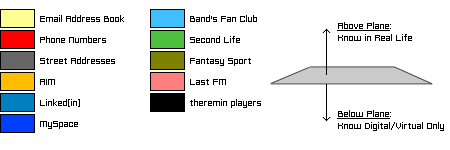



The graph above (may take a moment to load, and requires QuickTime) shows the embedded relationship of each social contact list (This visual was inspired by a similar infographic on Matt Dickman’s site, with an added dimension in order to differentiate flesh-and-blood relationships, with virtual ones.). Being able to distinguish each individual congregation of contacts is not as important as the trend it exposes— how some networks assist with real-life relationships, while others develop virtual relationships, and still others serve as communication tools irrespective of the divide.

The first thing that is immediately apparent is that Email and Instant Messaging are still the killer apps, and that the people you really know are in your Phone list. Beyond that, some interesting shapes tape form. Linked[in] is a powerful tool for managing the relationships that you already have, while MySpace is on the outside (Before someone points it out, some people may only invite close friends on MySpace, while other so-called “open networkers” may see most of their Linked[in] sphere dip below the plane. This is just one scenario, but my anecdotal observations suggest this is more the norm.).

What I also find very fascinating are the small spheres, like the band’s fan site or the theremin forum. This is where people connect with others who share their deep common interests. This is the long-tail of social networking. Let’s have a look at a couple of examples:

Gig Posters is the ultimate online library of concert posters. All posters in the library are uploaded either by collectors (fans of the band or the poster artist) or uploaded by the poster artists themselves. There is a shop where artists can sell their goods, and a community area in the form of a bulletin board. This is still the most successful form of vertical market online community.

The Purse Blog/Forum is a shallow little website for women who are passionate about their purses. It has a blog where all the new styles are introduced. A forum where members can socialize, discuss fashion, show off their purse collections and share tips on how to spot counterfeits. An auction page, that members cannot sell on until they’ve posted X number of times in the forum, and have earned enough points-of-trust from fellow forum members (a much more stringent screening process that anything in place at eBay).

These are the sort of vertical market communities that marketers should be studying when they want to see a successful social media model for clients hoping to build online community around their brands.

But where are all the hip and trendy, high-tech and sexy new social networking apps of the moment? Nowhere to be found. What these sites are brimming with are happy loyal members of tight-knit online communities. When you’re on most of these sites, they ask in your user profile whether you wish to share your website URL, you email address and several different instant messenger application identities. Depending on which apps you have and wish to share, these will show up as a series of buttons along the bottom edge of your forum postings. When the major bulletin board applications (vBulletin, Invision Board, Ikon Board) begin to include the option for a Twitter, Jaiku, Pounce button, and more importantly when the users of the bulletin boards begin to activate the button in their forum profile, that’s when you’ll know which of these apps has arrived.

But the true lesson to be learned from these sites is that, irrespective of technology, content is still king.


For those social media jockeys in need of a tool to help keep all of their net identities organized, John Swords’ blog pointed me in the direction of Onxiam which, while not the most elegant solution, does at least gather all one’s identities in one single directory.


PrintView Printer Friendly Version

Reader Comments (2)

Chris -- First off, like I said, nice work on the graphic and nice thought on this piece. I think you are completely dead-on in pointing out that the general, average person is not nearly up to the level of interaction that we in the space are. I'd say there's a good year+ gap there and we need to be cognizant of that fact in marketing.

Your long tail examples are also good to prove this point. Where people find a common interest, the level of interaction and community building increases rapidly. I've seen this first hand in the work I've done with professional sports teams. The MySpace example is still probably a little too aggressive for the average American consumer. I think network memberships are growing, but there are a lot of people for whom email, browser, phone and IM are *the* tools for communication.

To the points about services like Twitter and Pownce, these are bleeding edge when compared to where the consumer is, but don't count them out. I can see individual communities adopting these services or a form of service like them to enable more community building. How much more powerful could the Gig Posters site be if they had a Twitter account and posted to it regularly? Members of that site are looking for ways to connect more deeply and I don't see why they wouldn't give Twitter a try.

I think the point in any marketing campaign is to look at the consumer, make sure your strategy is on target to them and look where you can take them to the next step. Twitter isn't for every person, but it may be the next step for a lot of communities out there. Message boards only go so far.
July 12, 2007 | Unregistered CommenterMatt Dickman
Matt wrote:
> ...Message boards only go so far.

True, but they're still the corner stone of most online communities. Then IM brings the conversation to one-on-one in real time between individual participants. Apps like Twitter make a behavioral change in the way we use these communications.

What are blogs, but networks of message boards? (There are three other graphs I considered for this posting. I'm about to be very busy, and don't know when I'll have time, but perhaps over the weekend or next week I'll amend the post, or elaborate with a follow-up. graph 1 and 2- comparative graphs of the structure of blog posts vs bulletin board posts, and 3- the relationship between communication tools and communities.)

Matt wrote:
> ...I can see individual communities adopting these
> services or a form of service like them to enable
> more community building...

Absolutely. As I said:
+ ...When the major bulletin board applications...
+ begin to include the option for a Twitter, Jaiku,
+ Pounce button, and more importantly when the users
+ of the bulletin boards begin to activate the button
+ in their forum profile, that’s when you’ll know
+ which of these apps has arrived.

Here is an interesting observation.

As you came to post your response, we engaged in an IM. This gave us a one-on-one exchange in realtime while you formed your reply. Then, after making your response, John Swords Twittered the URL. I have my stats open in another window and rather instantaneously received 20 hits with "twitter.com" as the referrer.

(Can we discuss a navel gazing exercise?)

It was great to see that in action.

My position on social media overload has not changed. We're experiencing this because we work in this field. The average user does not know these products exist. When they do cross the threshold into mass market adoption, they will probably have been assimilated into an existing product or service (they'll have to, the masses won't tolerate the inconvenience of juggling multiple services/platforms). They will be very useful when that does happens. But these inconveniences everyone is complaining about right now are a result of our proximity to them as early adopters. That's my point. Not that they're bad, or in any way wrong.

Furthermore, good content still trumps all.
July 13, 2007 | Registered CommenterChris

PostPost a New Comment

Enter your information below to add a new comment.

My response is on my own website »
Author Email (optional):
Author URL (optional):
Post:
 
Some HTML allowed: <a href="" title=""> <abbr title=""> <acronym title=""> <b> <blockquote cite=""> <code> <em> <i> <strike> <strong>